
“Every discovery begins with curiosity. Every collaboration brings us closer to better treatments. Every patient reminds us why this work matters.”
Patient Journeys
Every individual living with RFC1-related disease has a unique story. Some have spent years searching for a diagnosis. Others have navigated challenges with balance, neuropathy, chronic cough, vision changes, or daily activities. Along the way, they have discovered resilience, practical strategies, and sources of hope that can encourage others facing similar journeys.
These stories celebrate perseverance, provide encouragement to those who are newly diagnosed, and remind us that behind every scientific discovery are real people whose lives inspire the work we do.
A Family Journey to Hope
Part 1: The Family Behind the Diagnosis
By Nanette Presswell
“Srećna Slava”—Happy Slava—rang around the room as the Stojanovich family gathered in January 2007 to celebrate its annual Serbian Orthodox family tradition. There was food, laughter, conversation and, later, the Kolo, danced together with linked arms. As the evening ended, I noticed that all four Stojanovich brothers, then in their late 40s to late 50s, were struggling with their balance. Two fell on the sloping lawn, laughing and joking with their characteristic humour.
My heart sank. Dušan, the eldest brother and my soulmate, had been diagnosed with idiopathic peripheral neuropathy, but this did not explain his balance difficulties. Could all four brothers have the same underlying illness?
Dušan was born in a refugee camp in Austria in 1949 after his parents were displaced during World War II. He arrived in Australia at 11 months old. We met at the University of New South Wales in 1972 and married in 1979. Together, we raised our two daughters, sharing decades of love, creativity and family life.
For years, the brothers had also experienced a persistent, unexplained cough. We could not have known it might be an early clue to a broader neurological condition.
In 2008, specialists in Melbourne recognised Dušan’s cerebellar ataxia, sensory neuronopathy and vestibular dysfunction. Eventually, we had a name: CANVAS. The discovery of its genetic cause in 2019 finally offered an explanation.
Living Together, Adapting Together
All four brothers experienced progressive illness of varying severity. Dušan and his brother John died from complications of CANVAS in 2022, within two months of each other. Their two surviving brothers continue to live with significant consequences of RFC1-related disease.
Yet illness never extinguished Dušan’s creativity, humour or enthusiasm for life. For much of the two to three decades of his illness, we continued to enjoy life, making adjustments along the way.
We loved travelling. In Morocco in 2015, Dušan insisted on bringing a smart but rather large suitcase—with no wheels—that he had bought on special at Aldi! Manoeuvring it up the broad stone “donkey stairs” taught us a lesson.
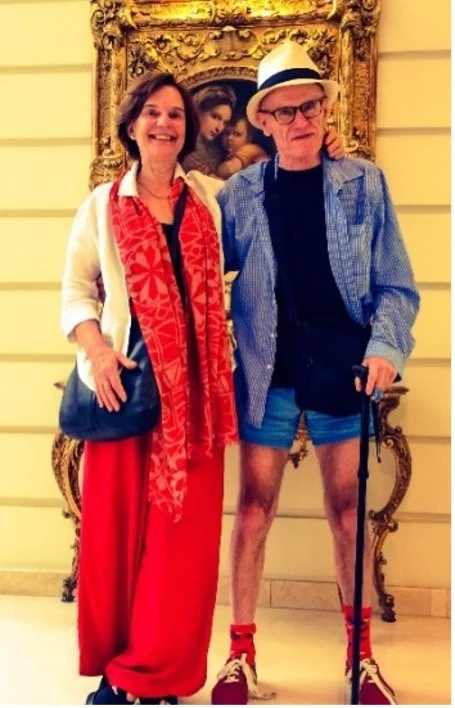
For our European trip in 2018, we travelled much lighter. I walked arm-in-arm with Dušan, who also used a walking stick. In Saint Petersburg, a destination on his bucket list, we quickly learnt the Russian word for help. People were wonderfully willing to assist. We were reminded of the kindness of strangers and the importance of accepting help.
Nanette and Dušan in Saint Petersburg, 2018.
As Dušan needed more support at home, a home-care package enabled us to find wonderful carers who recognised his interests. They helped him continue painting and enjoying outings. As a former civil engineer, he particularly loved visiting local building sites to watch construction. These ordinary activities brought enormous pleasure.
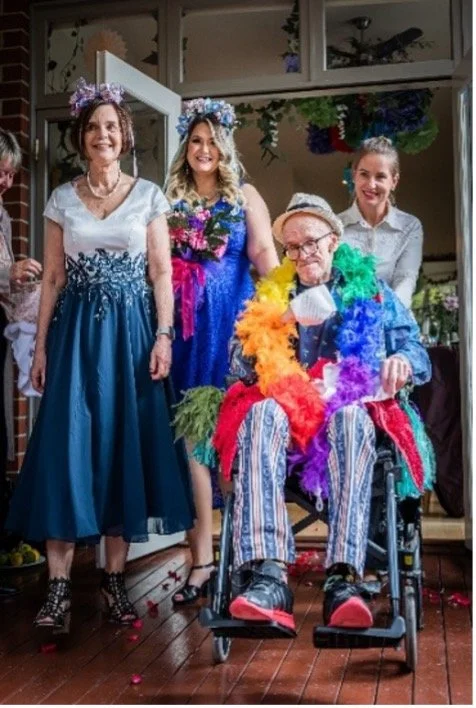
Family occasions remained precious. Our youngest daughter brought forward her wedding to April 2021 so that Dušan, then using a wheelchair, could still walk her down the aisle. It was a very special moment for us all.
Dušan, carer Sandra and Nanette with their daughter on her wedding day, April 2021.
What Helped Me as a Carer
Caring for someone with progressive neurological disease can be physically exhausting, emotionally confronting and isolating. Every family’s experience is different, but these are some things that helped me.
Accept help and make time for yourself. I continued working part-time and arranged for trusted people to care for Dušan, giving me time to recharge. Accepting help is essential, not a failure.
Stay connected. Friends who simply listen can be invaluable. Other affected families, a trusted GP, a multidisciplinary care team, counselling and respite can all form part of a support network.
Recognise grief and loss. Grief can begin long before someone dies. Changes in independence, abilities, shared activities and anticipated futures affect both the person with the illness and those close to them, sometimes differently.
Respond with patience. Frustration can reflect distress, loss of control or difficulty communicating. Stepping back to consider what someone may be experiencing can help everyone respond with greater compassion.
Balance independence and safety. Preserving dignity and choice matters, even as support needs change.
Keep meaningful activities in daily life. Time outdoors, creative interests and family occasions can make an enormous difference.
Holding On to Hope
As both a GP and an affected family member, I wanted our experience to help improve the journey for other families. That wish led me into research advocacy—a part of my story I look forward to sharing in a future issue.
Our family’s experience has included uncertainty, disability, loss and grief. It has also shown us the enduring importance of friendship, creativity, humour and generosity.
Through RFC1 support groups, I have encountered extraordinary wisdom, kindness and resourcefulness. Sharing our experiences helps us feel less alone and gives us much to offer one another.
I thank Dr. Allan Tissenbaum for inviting me to contribute to the RFC1 Foundation newsletter and commend him for his initiative in establishing the Foundation.
-
Before My Diagnosis
I first noticed a dry cough for no apparent reason in 1983. Medical examinations revealed no cause, so my doctor suggested it was a stress-related nervous cough. This has continued right up to today. Then around 2005 I had what I described as an electric shock in my leg. This occurred about every 20 or 30 seconds for about 12 hours. My doctor had no explanation for it. I also noticed that if I lightly touched the place on my leg that was having the so-called electric shock, the touch activated the pain. These pains re-occurred every 12 or 18 months, in different parts of my body, until around 2020. But, in 2016 I started having tingling pains in my feet every night, about 5 to 10 minutes aper going to bed. Because these pains only occurred aper I lay down I thought they were due to a lower-back injury I had when I was around 25 years old, so I went to see an osteopath who said it wasn't my back and he advised me to see a neurologist. The neurologist diagnosed peripheral neuropathy, and I started going to a physiotherapist to help with this. These pains have got steadily worse in the last 10 years and now occur at any time and affect my legs, feet and lately my hands. The tingling sensations in my feet are also now permanent. In the summer of 2024, I started to have balance problems. It wasn't a case of my head spinning; I was just losing my balance, especially when I turned round or stood up from a sitting position. My doctor sent me to a physiotherapist who specialised in balance problems. He did various head movement tests and then advised me to see an ear, nose and throat specialist. The specialist did various head movement and eye movement tests and explained that I had zero vestibulo-ocular reflex. Then, seeing in my medical records that I had neuropathy, he asked if I had an unexplained cough. I looked at my wife, and she looked at me, and we both laughed and said I had coughed for 40 years. He then suggested that maybe I had CANVAS. When we asked what that was, he explained all about it and suggested I go for a genetic test for verification. I gave a blood sample for analysis in February 2025, and in June 2025 it was confirmed that my RFC1 gene was defective and, yes, I had CANVAS. This report was sent to my neurologist and to my doctor. Neither of them had any prior knowledge of CANVAS and had no idea what treatment to prescribe.
Receiving the Diagnosis
On the advice of an ear, nose and throat specialist, I had a blood sample analysed in 2025. The result was given four months later. Finally, I had confirmation that all my health problems were linked, and I only had one illness—CANVAS —and not several unexplained issues. That was a relief, even if there is no cure.
Living with RFC1 Today
Before RFC1-related problems developed, I was quite active. In the far distant past, I was on a gymnastics team, and I was an athlete specialising in long jump and triple jump. During married life with three children, we did various activities such as hill-walking, cycling and family holidays—all the normal family activities. I did many home improvements and gardening, too. In the last five years or so, I have had to stop most activities because of balance problems, and more recently even reading has become difficult due to eye-coordination problems. This is hard to accept, and I open feel a bit guilty at having to rely on others to do tasks that were my responsibility until recently.
What Has Helped?
I had been going to a physiotherapist since 2016, and these sessions were increased to two per week. My physiotherapist had never heard of CANVAS either, but all the health professionals I have met have found it very interesting and have started to find out more about it. At the beginning of 2026, I started having vision problems when I moved my head. Since then, I have been having eye-movement exercises with an orthoptist once per week. In February 2026, I had a really bad weekend of intense neuropathy pains, and I was determined to see a health professional who had some knowledge or experience of CANVAS. On the advice of the team who carried out my genetic test in 2025, I contacted Professor Yann Pereron at the University Hospital of Nantes in western France, about an hour from my home. I got an appointment with him at the beginning of June. He heads research into rare neurological diseases at the University Hospital in Nantes. My wife and I met him, and he explained that he didn't have a magic white rabbit to pull from a hat—there is no treatment to cure CANVAS; all that can be done is to try to make living with it easier. He did say that, with my permission, I could be added to a database being compiled by specialists in France that lists patients' symptoms and treatments. If a new treatment is discovered, they can contact me rapidly. He asked me about the symptoms I had, when they first appeared, what treatment I had and what my physiotherapist did. With my physiotherapist, I do exercises to strengthen my legs and increase the sensitivity of my feet, as well as hand-feet and arm-leg coordination. She also works on my balance and coordination when I change position from sitting to standing, turn around, or reach higher or lower for objects. She explains what she is doing and why and watches closely every movement I make. The objective is to get my brain to compensate rapidly and automatically for any coordination problem. The orthoptist does exercises to try to make my brain compensate rapidly for the vision deficiencies I have. These occur when I move my head while walking, speaking, eating or reading. When I saw the specialist in Nantes, he said I must not stop these therapies even if I feel they are not helping. He explained that they are helping, sometimes very slowly, but if I stop them my situation could deteriorate rapidly. Outside the home, I walk with a walking stick or cane. This helps me keep my balance and also alerts others to the fact that I'm not very stable when moving about. In the home, there is always a wall or furniture to hold onto. I also carry information about CANVAS so that, when people ask why I'm walking with a cane, I can show them that what I'm experiencing is not unique to me.
Advice for Others
Since being diagnosed with CANVAS, I have found it helpful to find out as much as possible about the illness and to share the information with family and friends, and especially with medical professionals who generally have no prior knowledge of it. In the home, my wife and I have taught each other to laugh about my wobbles and to try to keep up our morale. It's not always easy, especially with the neuropathy pains and the swings in blood pressure, open resulting in loss of consciousness for 30 seconds or so. I live in France, and here we have a very good WhatsApp and Facebook support group with monthly Zoom meetings. It's good to share experiences and to support each other, showing that one is not alone. Above all, don't allow yourself to become depressed. Find people to encourage and support you. Find a good church community to support and pray for you. Keep active as long as you can. When you think something is impossible, just push a little harder. I've also had to insist on seeing health professionals who understand CANVAS in its entirety and who can perhaps fine-tune the treatment.
Looking Forward
Because CANVAS affects the whole body and was only recently identified as a medical syndrome, neurologists and medical researchers find it very interesting, and new discoveries are being made regularly. This gives me hope that in the future—the near future, I hope—things will be discovered to ease the pain and make everyday living so much easier.
In One Sentence
“Living with CANVAS has taught me how wonderful the human body is and how lucky I have been to live a healthy life up to now at 79 years old.”
-
Before My Diagnosis
My husband noticed my persistent cough when I was in my mid-thirties, long before I paid attention to it. A chest X-ray was normal, so I assumed it was an allergy. During the COVID pandemic, I became more aware of how often I coughed, but I still had no reason to connect it to a neurological condition.
Around 2021, I began having episodes of burning pain on the top of one foot. Pins and needles and numb areas in my feet followed. After a long flight in 2023, one side of a foot stayed numb for about two days. Blood tests did not explain it. Later I developed tingling in my hands and had a frightening choking episode, which prompted a neurology referral. My initial examination and scans did not give me a clear answer, and I was prescribed medication to help me sleep through the uncomfortable sensations.
My brother had also undergone years of investigation for muscle wasting and balance problems. Because of that family history, I saw a neuromuscular specialist. Nerve conduction studies unexpectedly showed a moderately severe length-dependent axonal polyneuropathy, although my muscle function was normal.
Receiving the Diagnosis
Further genetic testing eventually brought an answer: in October 2025, I received a letter saying that my RFC1 result was consistent with CANVAS. My brother was tested afterward and found to be a carrier. His separate muscle condition remains unexplained.
Living with RFC1 Today
At present, my neuropathy affects me mildly. Symptoms are mostly controlled, and difficult nights have become less frequent since I changed from amitriptyline to duloxetine. The hardest part is the uncertainty: I do not know how my condition will progress or whether each new symptom is related. Recent swallowing and bowel symptoms have led to further investigation. Some findings may be related to nerve sensitivity or autonomic function, but their cause has not been established.
Looking Forward
I would rather understand what is happening, even when the answers are incomplete. Research and the growing RFC1 community give me reasons to remain hopeful.